
The manufacturing sector offers more than you might think at first glance. From entry-level roles to management positions, there is work for people with diverse backgrounds and ambitions. Whether you are looking for temporary staffing or permanent employment, understanding the various professions helps you as an employer to make the right choices.
Upforce helps companies in manufacturing and logistics to fill those positions quickly and effectively. Get in touch and within 24 hours you'll know where you stand.
What jobs are there actually in the manufacturing sector?
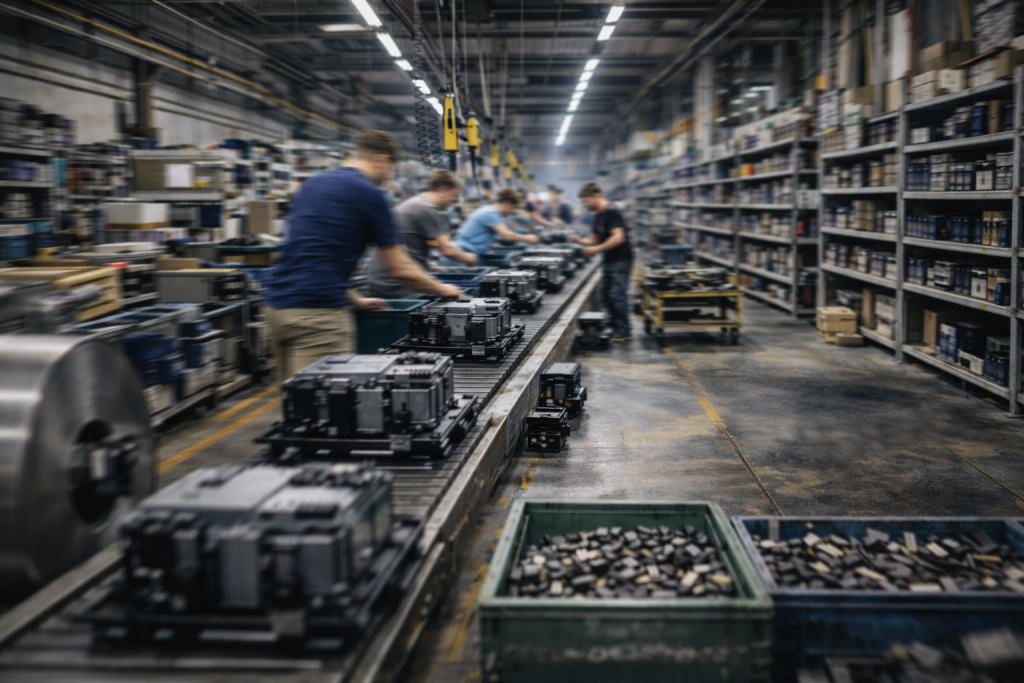
Working in manufacturing means operating in an environment driven by precision, collaboration and continuity. The manufacturing sector encompasses a wide range of roles, from simple manual labour to technically specialist work. Exactly which jobs exist depends heavily on the type of company and the production environment.
Most entry-level roles in manufacturing are those of production operative and packer. Production operatives work on the production line, carrying out tasks such as operating machinery, assembling components and checking finished products. A packer ensures products are ready for dispatch. This work does not require prior specific training, but does demand attention, accuracy and a good work ethic.
One step further are roles such as machine operator and assembly mechanic. An operator is responsible for independently operating and monitoring machines. This requires technical knowledge and the ability to react quickly to deviations in the production process. An assembly mechanic puts together products or components according to a fixed work sequence, where precision and technical insight are essential.
In addition, there is the role of quality control officer, who monitors whether final products meet the set requirements. Depending on the industry, specific quality standards apply here, such as HACCP in the food industry. A quality control officer works closely with the rest of the production team and is an indispensable link in maintaining production standards.
The warehouse operative also plays a relevant role within manufacturing companies. Where production and logistics come together, the warehouse is the connecting factor. Goods must arrive, be stored and make it to the shop floor on time. If you want to know more about personnel in that logistical part of your business, you can find out more on the about us page employment agency in logistics more information about how we support that.
Career progression in the manufacturing sector: from shop floor to team leader
A job in industry doesn't have to stand still. The opportunities for career progression within the manufacturing sector are more concrete than many people think. Anyone who does their job well, is reliable and has an affinity for teamwork is eligible for a next step.
The most common career path runs from production operative to group leader or production team leader. In that role, you are no longer solely engaged in hands-on work, but also bear responsibility for the planning and management of a shift. That requires different skills: maintaining an overview, communicating and solving problems while the production process continues as normal.
Many manufacturing companies are keen to invest in their personnel and offer in-house training to prepare employees for management positions. Think of training courses concerning workplace safety, VCA certification and process optimisation. Employees with a vocational education background and relevant experience in the industry regularly take that step. We often see this pattern in companies in the region that work with Upforce: someone starts as a production worker and is promoted to a coordinating role within one or two years.
That career progression is not only good for the employee, but also for you as an employer. You build up knowledge internally, increase your team's engagement and reduce dependence on a constant influx of new recruits. A stable team with prospects performs better and is less likely to leave the organisation.
What determines the salary in manufacturing?
What someone earns gross per month in manufacturing depends on several factors: the job role, the sector, the level of experience, and the working hours. In the Netherlands, manufacturing work generally falls under a collective labour agreement (CLA), such as the CLA for the metal industry, the food and beverage industry, or the agency work CLA.
A production worker with no experience will in most cases earn around the statutory minimum wage, but that increases quickly as more responsibility is added. Shift work also entails an allowance. Those who work in the evening, at night or at the weekend receive an allowance on top of their basic salary. That can increase the final income considerably. For companies, this is relevant when determining total labour costs and when comparing different types of contract. If you want to know which manufacturing collective labour agreement applies to your situation, it is advisable to go through this together with a specialist.
Alongside salary, some roles offer extra benefits such as travel allowance, pension accrual via the agency collective labour agreement, or access to company training. Housing plays a role, especially for international employees. For companies looking for employees where this needs to be arranged, Upforce also offers broadcasting including accommodation so that the practical side is properly arranged for both you and the employee.
The role of a production operative: what does it really involve?
Working in production means working in a dynamic environment where structure and focus are central. That sounds contradictory, but it is true: the work itself is structured and repetitive, but the environment is constantly changing due to varying orders, different machines and collaboration with colleagues from diverse backgrounds.
Entry-level roles in production do not require a qualification, but they do require the right attitude. Accuracy is not an afterthought; it is a basic requirement. Anyone who works carelessly on the production line causes scrap or quality issues that lead to delays further down the process. Candidates who understand this and take it seriously are precisely who manufacturing companies are looking for.
When selecting employees for production roles, Upforce therefore looks beyond work experience alone. Motivation, work ethic and whether someone fits in with your company's working methods are at least as important. Someone with limited industry experience but the right attitude often performs better in practice than someone with an impressive CV but little commitment. You can read more about how we approach this for companies in the manufacturing sector on our about us page temping agency for manufacturing.
For employers who also think on a strategic level about their workforce planning and what is required for it, the page offers for employers a good overview of what that collaboration looks like in practice.
Ready to find production staff who are a genuine fit?
The manufacturing sector offers a wide range of roles, from entry-level vacancies to specialised operator roles and management positions. For every level of that structure, the right person in the right place makes the difference between a production process that runs smoothly and one that constantly creaks and groans.
Upforce helps manufacturing companies to fill those positions structurally well, with employees who not only can handle the work but also fit the way your company works. No wasted time on candidates who drop out after a week. No administrative hassle. Just people who turn up and do their job well.
Get in touch and within 24 hours you'll know where you stand.
More posts